NCERT Class 8 - Exercise 9.2
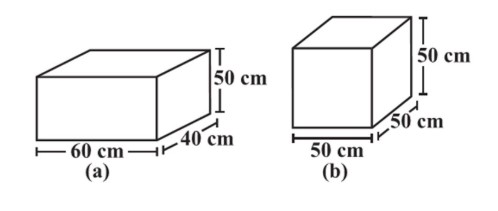
Dimensions:
Length \(l = 60\) cm, Breadth \(b = 40\) cm, Height \(h = 50\) cm.Total Surface Area (TSA):
\( TSA_A = 2(lb + bh + lh) \)\( TSA_A = 2((60 \times 40) + (40 \times 50) + (60 \times 50)) \)
\( TSA_A = 2(2400 + 2000 + 3000) = 2(7400) = 14800 \) cm\(^2\)
Dimensions:
Length \(l = 50\) cm, Breadth \(b = 50\) cm, Height \(h = 50\) cm.Total Surface Area (TSA):
This is a cube with side \(a = 50\) cm.\( TSA_B = 6a^2 = 6(50^2) = 6(2500) = 15000 \) cm\(^2\)
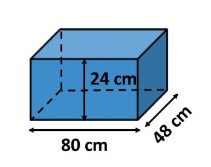
Step 1: Find the surface area of one suitcase
Dimensions of one suitcase: \(l = 80\) cm, \(b = 48\) cm, \(h = 24\) cm.\( \text{Area of one suitcase} = 2(lb + bh + lh) \)
\( = 2((80 \times 48) + (48 \times 24) + (80 \times 24)) \)
\( = 2(3840 + 1152 + 1920) = 2(6912) = 13824 \) cm\(^2\)
Step 2: Find the total area for 100 suitcases
\( \text{Total area} = 100 \times 13824 = 1,382,400 \) cm\(^2\)Step 3: Find the required length of tarpaulin
Width of tarpaulin = 96 cm. Let the required length be \(x\) cm.Area of tarpaulin = \( \text{Length} \times \text{Width} \)
\( 1,382,400 = x \times 96 \)
\( x = \frac{1,382,400}{96} = 14400 \) cm
Step 4: Convert the length to metres
Since 1 m = 100 cm, we divide by 100.\( \text{Length in metres} = \frac{14400}{100} = 144 \) m
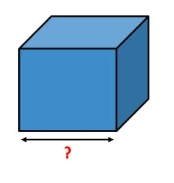
Given:
Total Surface Area (TSA) = 600 cm\(^2\).Formula:
The formula for the surface area of a cube is \( TSA = 6a^2 \), where \(a\) is the side length.Calculation:
\( 600 = 6a^2 \)\( a^2 = \frac{600}{6} = 100 \)
\( a = \sqrt{100} = 10 \) cm
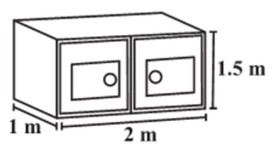
Given:
Dimensions of the cabinet: \(l = 2\) m, \(b = 1\) m, \(h = 1.5\) m.Formula:
Area to be painted = Total Surface Area of Cabinet - Area of BottomTotal Surface Area (TSA) of cuboid = \( 2(lb + bh + lh) \)
= \( 2(2 \times 1 + 1 \times 1.5 + 2 \times 1.5) \)
= \( 2(2 + 1.5 + 3) = 2(6.5) = 13 \) m\(^2\)
Area of Bottom = \( l \times b \) (since the bottom is a rectangle with length and breadth)
= \( 2 \times 1 = 2 \) m\(^2\).
Thus, the area she painted
= \( \text{TSA of Cabinet} - \text{Area of Bottom} \)\[= 13 - 2 = 11 m^2 \]
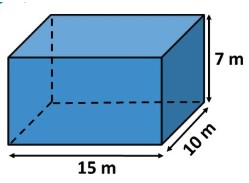
Given:
Hall dimensions: \(l = 15\) m, \(b = 10\) m, \(h = 7\) m.Area covered by one can = 100 m\(^2\).
Step 1: Find the total area to be painted
= The area (TSA) of Room - Area of floor.Area of Room = 2(lb + bh + lh)
\[= 2((15 \times 10) + (10 \times 7) + (15 \times 7)) \] \[= 2(150 + 70 + 105) = 2(325) = 650 m^2 \] Area of floor = \(l \times b\). \[= 15 \times 10 = 150 m^2 \].
Thus, Total Area to be painted = \( 650 - 150 = 500 m^2 \)
Step 2: Find number of cans needed for painting room:
Area covered by 1 can = \(100 m^2\)
Thus, Number of cans used for painting \(500 m^2\) = \( \frac{\text{Total Area}}{\text{Area per can}} \)
\( = \frac{500}{100} = 5 \)
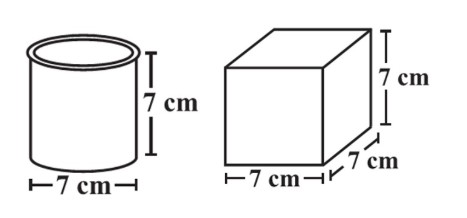
Similarities:
Both figures are 3-dimensional solid shapes.Differences:
- A cube has flat faces, while a cylinder has a curved surface. - A cube has 6 faces, 12 edges, and 8 vertices. A cylinder has 3 faces (two circular, one curved), 2 edges (circular), and no vertices.
Comparison of Lateral Surface Area (LSA):
Let's assume the dimensions are consistent (e.g., cube side = 7 cm, cylinder diameter = 7 cm, cylinder height = 7 cm).Cube:
LSA = \(4a^2 = 4(7^2) = 4 \times 49 = 196\) cm\(^2\).
LSA = \(2\pi rh = 2 \times \frac{22}{7} \times 3.5 \times 7 = 2 \times 22 \times 3.5 = 154\) cm\(^2\).
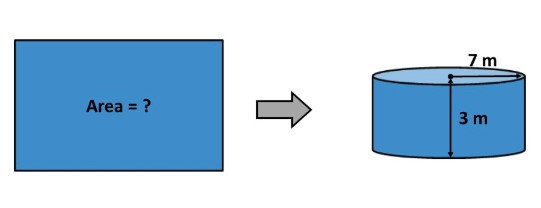
Given:
Radius \( (r) = 7\) m, Height \((h) = 3\) m.Formula:
The amount of sheet metal required for a closed tank is its Total Surface Area (TSA).\( TSA = 2\pi r(r + h) \)
Calculation:
\( TSA = 2 \times \frac{22}{7} \times 7 \times (7 + 3) \)\( = 2 \times 22 \times 10 = 440 \) m\(^2\)
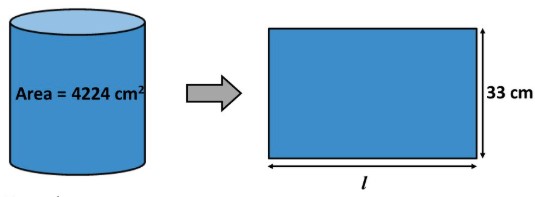
Analysis:
When a cylinder is cut and unrolled, it forms a rectangle. The area of this rectangle is the Lateral Surface Area (LSA) of the cylinder. The width of the rectangle is the height of the cylinder, and the length of the rectangle is the circumference of the cylinder's base.Given:
Area of rectangular sheet = 4224 cm\(^2\).Width of rectangular sheet = 33 cm.
Step 1: Find the length of the rectangular sheet
Area = Length \(\times\) Width\( 4224 = \text{Length} \times 33 \)
\( \text{Length} = \frac{4224}{33} = 128 \) cm
Step 2: Find the perimeter of the rectangular sheet
Perimeter = \(2(\text{Length} + \text{Width})\)\( = 2(128 + 33) = 2(161) = 322 \) cm
Analysis:
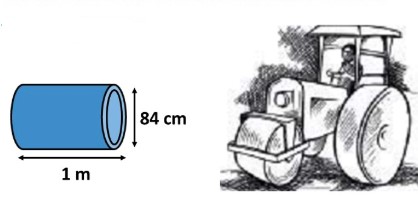
The area covered by the road roller in one revolution is its Lateral Surface Area (LSA).Given:
Diameter = 84 cm, so Radius \(r = 84/2 = 42\) cm.Length (height) \(h = 1\) m = 100 cm.
Step 1: Find the area covered in one revolution
Area per revolution = LSA of cylinder = \(2\pi rh\)\( = 2 \times \frac{22}{7} \times 42 \times 100 \)
\( = 2 \times 22 \times 6 \times 100 = 26400 \) cm\(^2\)
Step 2: Find the total area of the road
Total area = Area per revolution \(\times\) Number of revolutions\( = 26400 \times 750 = 19,800,000 \) cm\(^2\)
Step 3: Convert the total area to m\(^2\)
\( 1 \text{ m}^2 = (100 \times 100) \text{ cm}^2 = 10,000 \) cm\(^2\).\( \text{Total Area in m}^2 = \frac{19,800,000}{10,000} = 1980 \) m\(^2\)
Analysis:
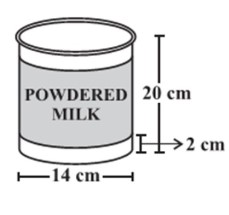
The label is a rectangle with a length equal to the circumference of the cylinder's base and a height that is 4 cm less than the cylinder's height (2 cm from top and 2 cm from bottom).Given:
Cylinder diameter = 14 cm, so Radius \(r = 14/2 = 7\) cm.Cylinder height = 20 cm.
Step 1: Find the height of the label
Height of label \(h_{label} = 20 - 2 - 2 = 16\) cm.Step 2: Find the area of the label
Area of label = (Circumference) \(\times\) (Height of label)Area = \(2\pi r \times h_{label}\)
\( = 2 \times \frac{22}{7} \times 7 \times 16 \)
\( = 2 \times 22 \times 16 = 44 \times 16 = 704 \) cm\(^2\)