NCERT Class 8 - Exercise 9.1
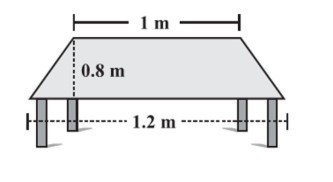
Given:
Parallel side \(a = 1\) mParallel side \(b = 1.2\) m
Height (perpendicular distance) \(h = 0.8\) m
Formula:
The area of a trapezium is given by:Calculation:
Substitute the values into the formula:\( \text{Area} = \frac{1}{2} \times (1 + 1.2) \times 0.8 \)
\( \text{Area} = \frac{1}{2} \times 2.2 \times 0.8 \)
\( \text{Area} = 1.1 \times 0.8 = 0.88 \) m\(^2\)
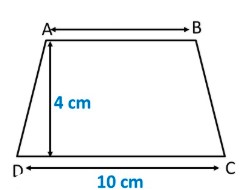
Given:
Area = 34 cm\(^2\)Parallel side \(a = 10\) cm
Height \(h = 4\) cm
Let the other parallel side be \(b\).
Formula:
Area of a trapezium:Calculation:
Substitute the known values:\( 34 = \frac{1}{2} \times (10 + b) \times 4 \)
\( 34 = 2 \times (10 + b) \)
Divide both sides by 2:
\( 17 = 10 + b \)
Subtract 10 from both sides:
\( b = 17 - 10 = 7 \) cm
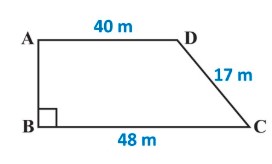
Given:
Perimeter of field = 120 mSide BC = 48 m, CD = 17 m, AD = 40 m
Step 1: Find the length of side AB
The perimeter is the sum of all sides: \( AB + BC + CD + AD = 120 \).\( AB + 48 + 17 + 40 = 120 \)
\( AB + 105 = 120 \)
\( AB = 120 - 105 = 15 \) m.
Since AB is perpendicular to the parallel sides, AB is the height of the trapezium.
Step 2: Find the area
Parallel sides are \( a = 40 \) m and \( b = 48 \) m.Height \( h = AB = 15 \) m.
\( \text{Area} = \frac{1}{2} \times 88 \times 15 \)
\( \text{Area} = 44 \times 15 = 660 \) m\(^2\)
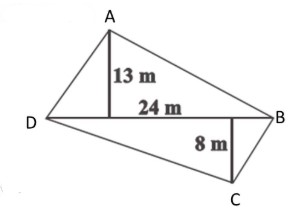
Given:
Diagonal \(d = 24\) mPerpendiculars \(h_1 = 8\) m and \(h_2 = 13\) m.
Formula:
The area of a quadrilateral is given by:Calculation:
Substitute the values into the formula:\( \text{Area} = \frac{1}{2} \times 24 \times (8 + 13) \)
\( \text{Area} = 12 \times 21 \)
\( \text{Area} = 252 \) m\(^2\)
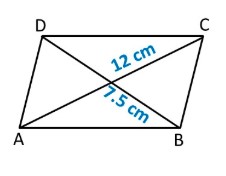
Given:
Diagonal \(d_1 = 7.5\) cmDiagonal \(d_2 = 12\) cm
Formula:
The area of a rhombus is given by:Calculation:
Substitute the values into the formula:\( \text{Area} = \frac{1}{2} \times 7.5 \times 12 \)
\( \text{Area} = 7.5 \times 6 \)
\( \text{Area} = 45 \) cm\(^2\)
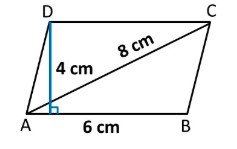
Given:
Side \(a = 5\) cmAltitude \(h = 4.8\) cm
Diagonal \(d_1 = 8\) cm
Step 1: Find the Area using side and altitude
A rhombus is a type of parallelogram. The area of a parallelogram is given by:Step 2: Find the other diagonal
We also know the area of a rhombus is \( \frac{1}{2} \times d_1 \times d_2 \). Let the other diagonal be \(d_2\).\( 24 = \frac{1}{2} \times 8 \times d_2 \)
\( 24 = 4 \times d_2 \)
\( d_2 = \frac{24}{4} = 6 \) cm
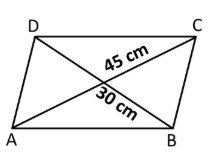
Given:
Number of tiles = 3000Diagonals of each tile: \( d_1 = 45 \) cm, \( d_2 = 30 \) cm
Cost of polishing = ₹ 4 per m\(^2\)
Step 1: Find the area of one tile in cm\(^2\)
Step 2: Find the total area of the floor in cm\(^2\)
\( \text{Total Area} = 3000 \times 675 = 2,025,000 \) cm\(^2\)Step 3: Convert the total area to m\(^2\)
Since 1 m = 100 cm, then 1 m\(^2\) = \( (100 \times 100) \) cm\(^2\) = 10,000 cm\(^2\).Step 4: Find the total cost of polishing
\( \text{Total Cost} = \text{Total Area} \times \text{Cost per m}^2 \)\( \text{Total Cost} = 202.5 \times 4 = 810 \)
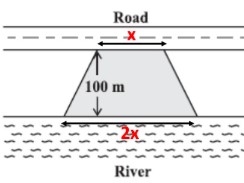
Step 1: Define the parallel sides
Let the length of the side along the road be \(x\) m.The length of the side along the river is \(2x\) m.
Step 2: Use the Area formula to find \(x\)
\( 10500 = \frac{1}{2} \times (3x) \times 100 \)
\( 10500 = 3x \times 50 \)
\( 10500 = 150x \)
\( x = \frac{10500}{150} = 70 \) m.
Step 3: Find the length of the side along the river
The side along the river is \(2x\).Length = \(2 \times 70 = 140\) m.
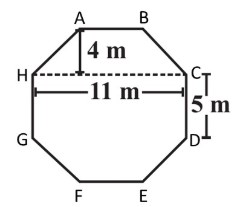
Analysis of the figure:
A regular octagon can be divided into a central rectangle and two identical trapeziums. From the figure, we have:- Parallel sides of the trapeziums: 5 m and 11 m.
- Height of the trapeziums: 4 m.
- Dimensions of the central rectangle: 11 m by 5 m.
Step 1: Find the area of one trapezium
Step 2: Find the area of the rectangle
Step 3: Find the total area
\( \text{Total Area} = (\text{Area of 2 trapeziums}) + (\text{Area of rectangle}) \)\( \text{Total Area} = (2 \times 32) + 55 = 64 + 55 = 119 \) m\(^2\).
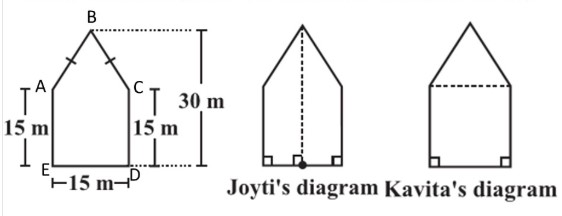
Parallel sides: \(a = 15\) m and \(b = 30\) m.
Height of each trapezium: \( \frac{15}{2} = 7.5 \) m.
Area of one trapezium: \( \frac{1}{2} \times (15 + 30) \times 7.5 = 168.75 \) m\(^2\).
Total Area = \( 2 \times 168.75 = 337.5 \) m\(^2\).
Side of the square = 15 m. Area = \( 15 \times 15 = 225 \) m\(^2\).
Base of the triangle = 15 m. Height = \( (30 - 15) = 15 \) m.
Area of the triangle: \( \frac{1}{2} \times 15 \times 15 = 112.5 \) m\(^2\).
Total Area = \( 225 + 112.5 = 337.5 \) m\(^2\).
Another way to find the area:
Another method is to enclose the pentagon in a large rectangle and subtract the areas of the outer triangles.1. Area of rectangle (30 m x 15 m) = \( 450 \) m\(^2\).
2. Area of two corner triangles = \( 2 \times (\frac{1}{2} \times 7.5 \times 15) = 112.5 \) m\(^2\).
3. Area of pentagon = \( 450 - 112.5 = 337.5 \) m\(^2\).
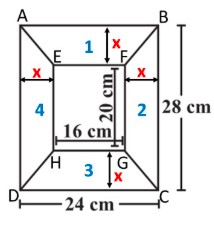
Analysis of the figure:
The frame consists of four trapeziums. The top/bottom sections are identical, and the left/right sections are identical. The width of the frame is the same everywhere. We can calculate this width:Width = \( \frac{\text{Outer Width} - \text{Inner Width}}{2} = \frac{24 - 16}{2} = 4 \) cm.
Step 1: Area of the top and bottom sections
These are trapeziums with parallel sides \(a = 20\) cm and \(b = 28\) cm. The height \(h = 4\) cm.Step 2: Area of the left and right sections
These are trapeziums with parallel sides \(a = 16\) cm and \(b = 24\) cm. The height \(h = 4\) cm.