Data Handling - Exercise 4.1
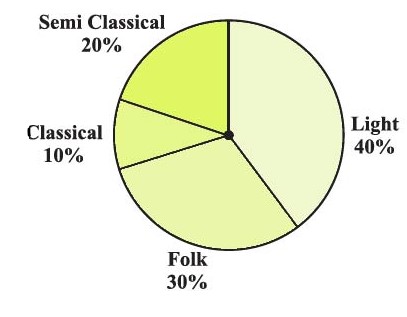 From this pie chart, answer the following:
- If 20 people liked classical music, how many young people were surveyed?
Solution 1
We are given that 10% of the people liked classical music, which is equal to 20 people.
(i) To find the total number of people, we use the information about classical music.
Let the total number of people be \(x\).
$$10\%\text{ of }x = 20$$
$$\frac{10}{100} \times x = 20$$
$$ \implies x = \frac{20 \times 100}{10} = 200$$
Answer: A total of 200 young people were surveyed.
2. Which type of music is liked by the maximum number of people?
(ii) By observing the pie chart, the sector with the largest percentage is for Light music (40%).
Answer: Light music is liked by the maximum number of people.
3. If a cassette company were to make 1000 CDs, how many of each type would they make?
(iii) To find the number of CDs of each type, we calculate the percentage of 1000.
Number of Classical CDs = $$10\%\text{ of }1000 = \frac{10}{100} \times 1000 = 100$$
Number of Semi-Classical CDs = $$20\%\text{ of }1000 = \frac{20}{100} \times 1000 = 200$$
Number of Folk CDs = $$30\%\text{ of }1000 = \frac{30}{100} \times 1000 = 300$$
Number of Light CDs = $$40\%\text{ of }1000 = \frac{40}{100} \times 1000 = 400$$
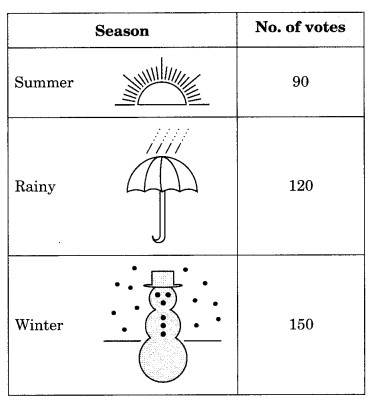
Q.2: A group of 360 people were asked to vote for their favourite season from the three seasons rainy, winter and summer.
Solution Q.2
1. Which season got the most votes?
(i) From the table, Winter received 150 votes, which is the highest number. Therefore, Winter got the most votes.
2. Find the central angle of each sector.
(ii) The total number of votes is 360, which corresponds to the total angle of a circle = 360 degrees. We will calculate the central angle for each season:
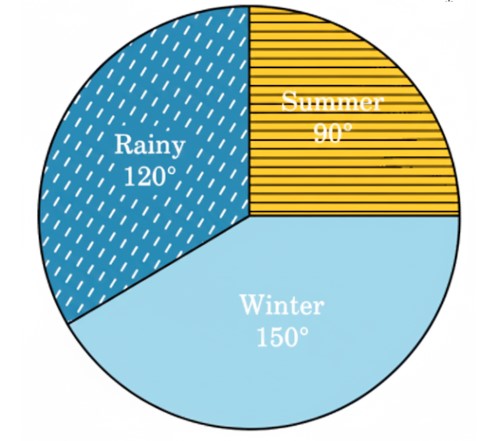
Central angle for Summer: $$\frac{90}{360} \times 360^{\circ} = 90^{\circ}$$
Central angle for Rainy: $$\frac{120}{360} \times 360^{\circ} = 120^{\circ}$$
Central angle for Winter: $$\frac{150}{360} \times 360^{\circ} = 150^{\circ}$$
3. Draw a pie chart to show this information.
(iii) Pie chart showing the calculated central angles.
Solution 3
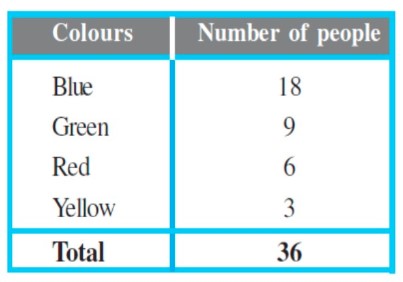
The total number of people is 36. We will calculate the central angle for each colour.
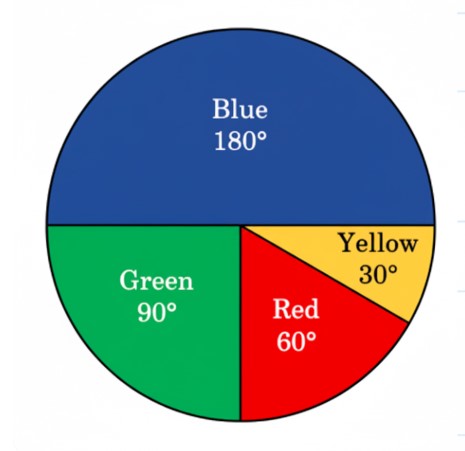
Central angle for Blue: $$\frac{18}{36} \times 360^{\circ} = 180^{\circ}$$
Central angle for Green: $$\frac{9}{36} \times 360^{\circ} = 90^{\circ}$$
Central angle for Red: $$\frac{6}{36} \times 360^{\circ} = 60^{\circ}$$
Central angle for Yellow: $$\frac{3}{36} \times 360^{\circ} = 30^{\circ}$$
A pie chart showing these angles.
Solution 4
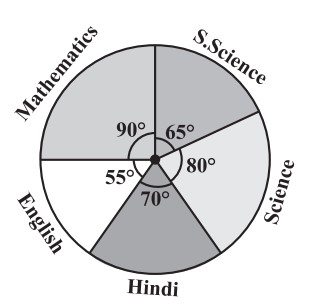
(i) To find the subject with 105 marks, we first find the central angle corresponding to 105 marks, knowing that 540 marks correspond to $$360^{\circ}$$.
Angle for 105 marks = $$\frac{360}{540} \times 105 = 70^{\circ}$$
According to the pie chart, the subject with a 70° central angle is Hindi.
Answer: The student scored 105 marks in Hindi.
(ii) We find the marks for Mathematics and Hindi using their central angles.
Marks in Maths = $$\frac{90^{\circ}}{360^{\circ}} \times 540 = 135$$
Marks in Hindi = $$\frac{70^{\circ}}{360^{\circ}} \times 540 = 105$$
Difference = $$135 - 105 = 30$$ marks.
Answer: The student obtained 30 more marks in Mathematics than in Hindi.
(iii) We can compare the sum of the central angles to determine if the sum of marks is greater.
Sum of angles for Social Science and Mathematics = $$65^{\circ} + 90^{\circ} = 155^{\circ}$$
Sum of angles for Science and Hindi = $$80^{\circ} + 70^{\circ} = 150^{\circ}$$
Since 155° > 150°, the sum of the marks in Social Science and Mathematics is more than that in Science and Hindi.
Solution 5
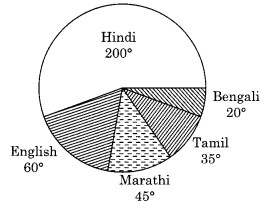
The total number of students is 72. We calculate the central angle for each language to draw the pie chart.
Central angle for Hindi: $$\frac{40}{72} \times 360^{\circ} = 200^{\circ}$$
Central angle for English: $$\frac{12}{72} \times 360^{\circ} = 60^{\circ}$$
Central angle for Marathi: $$\frac{9}{72} \times 360^{\circ} = 45^{\circ}$$
Central angle for Tamil: $$\frac{7}{72} \times 360^{\circ} = 35^{\circ}$$
Central angle for Bengali: $$\frac{4}{72} \times 360^{\circ} = 20^{\circ}$$
A pie chart drawn using these angles.