Exercise 5.7
1. Say True or False:
(a) Each angle of a rectangle is a right angle.
Solution: True.
Solution: True.
(b) The opposite sides of a rectangle are equal in length.
Solution: True.
Solution: True.
(c) The diagonals of a square are perpendicular to one another.
Solution: True.
Solution: True.
(d) All the sides of a rhombus are of equal length.
Solution: True.
Solution: True.
(e) All the sides of a parallelogram are of equal length.
Solution: False (Only opposite sides are equal).
Solution: False (Only opposite sides are equal).
(f) The opposite sides of a trapezium are parallel.
Solution: False (Only one pair of opposite sides is parallel).
Solution: False (Only one pair of opposite sides is parallel).
2. Give reasons for the following:
(a) A square can be thought of as a special rectangle.
Reason: A square has all the properties of a rectangle (four right angles and opposite sides equal). Therefore, it is a special type of rectangle where all sides are also equal.
Reason: A square has all the properties of a rectangle (four right angles and opposite sides equal). Therefore, it is a special type of rectangle where all sides are also equal.
(b) A rectangle can be thought of as a special parallelogram.
Reason: A rectangle has opposite sides parallel and equal, which satisfies the properties of a parallelogram. It is "special" because its angles are all 90°.
Reason: A rectangle has opposite sides parallel and equal, which satisfies the properties of a parallelogram. It is "special" because its angles are all 90°.
(c) A square can be thought of as a special rhombus.
Reason: A square has all sides equal and its diagonals are perpendicular to each other, which are properties of a rhombus. It is "special" because all its angles are 90°.
Reason: A square has all sides equal and its diagonals are perpendicular to each other, which are properties of a rhombus. It is "special" because all its angles are 90°.
(d) Square, rectangles, parallelograms are all quadrilaterals.
Reason: They all are closed plane figures made up of exactly four line segments.
Reason: They all are closed plane figures made up of exactly four line segments.
(e) Square is also a parallelogram.
Reason: A square has opposite sides parallel and equal, fulfilling the basic definition of a parallelogram.
Reason: A square has opposite sides parallel and equal, fulfilling the basic definition of a parallelogram.
3. A figure is said to be regular if its sides are equal in length and angles are equal in measure. Can you identify the regular quadrilateral?
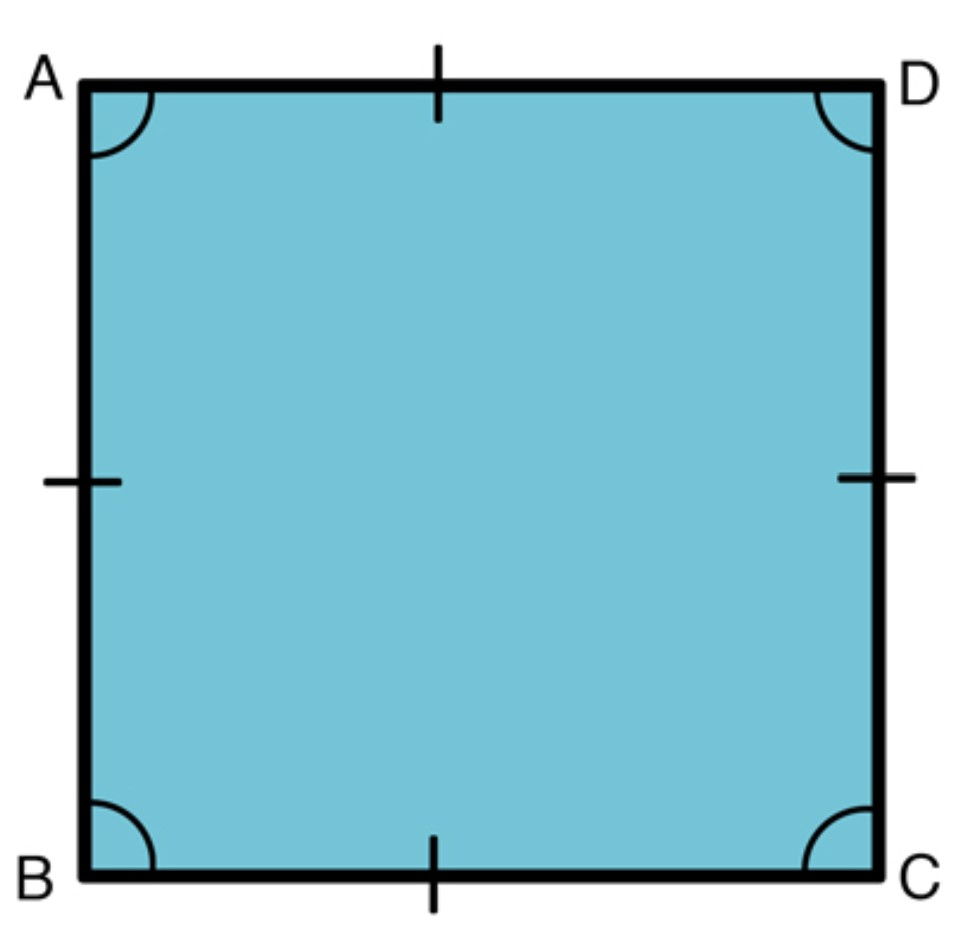
Solution: A Square is the only quadrilateral with all four sides equal and all four angles equal (each being 90°).
Therefore, the square is a regular quadrilateral.
Therefore, the square is a regular quadrilateral.