Exercise 5.6
1. Name the types of following triangles:
(a) Triangle with lengths of sides 7 cm, 8 cm and 9 cm.
Solution: Since all sides are different (7 cm, 8 cm, 9 cm) → Scalene triangle.
Solution: Since all sides are different (7 cm, 8 cm, 9 cm) → Scalene triangle.
(b) \(\triangle ABC\) with AB = 8.7 cm, AC = 7 cm and BC = 6 cm.
Solution: Since AB ≠ AC ≠ BC → Scalene triangle.
Solution: Since AB ≠ AC ≠ BC → Scalene triangle.
(c) \(\triangle PQR\) such that PQ = QR = PR = 5 cm.
Solution: Since all sides are equal (PQ = QR = PR = 5 cm) → Equilateral triangle.
Solution: Since all sides are equal (PQ = QR = PR = 5 cm) → Equilateral triangle.
(d) \(\triangle DEF\) with \(m\angle D = 90^\circ\).
Solution: Since one angle is 90° → Right angled triangle.
Solution: Since one angle is 90° → Right angled triangle.
(e) \(\triangle XYZ\) with \(m\angle Y = 90^\circ\) and XY = YZ.
Solution: Since one angle is 90° and two sides are equal → Isosceles right angled triangle.
Solution: Since one angle is 90° and two sides are equal → Isosceles right angled triangle.
(f) \(\triangle LMN\) with \(m\angle L = 30^\circ\), \(m\angle M = 70^\circ\) and \(m\angle N = 80^\circ\).
Solution: Since all angles are less than 90° → Acute angled triangle.
Solution: Since all angles are less than 90° → Acute angled triangle.
2. Match the following:
(i) 3 sides of equal length ↔ (e) Equilateral
(ii) 2 sides of equal length ↔ (g) Isosceles
(iii) All sides are of different length ↔ (a) Scalene
(iv) 3 acute angles ↔ (f) Acute angled
(v) 1 right angle ↔ (d) Right angled
(vi) 1 obtuse angle ↔ (c) Obtuse angled
(vii) 1 right angle with two sides of equal length ↔ (b) Isosceles right angled
(ii) 2 sides of equal length ↔ (g) Isosceles
(iii) All sides are of different length ↔ (a) Scalene
(iv) 3 acute angles ↔ (f) Acute angled
(v) 1 right angle ↔ (d) Right angled
(vi) 1 obtuse angle ↔ (c) Obtuse angled
(vii) 1 right angle with two sides of equal length ↔ (b) Isosceles right angled
3. Name each of the following triangles in two different ways: (You may judge the nature of the angle by observation)
(a)
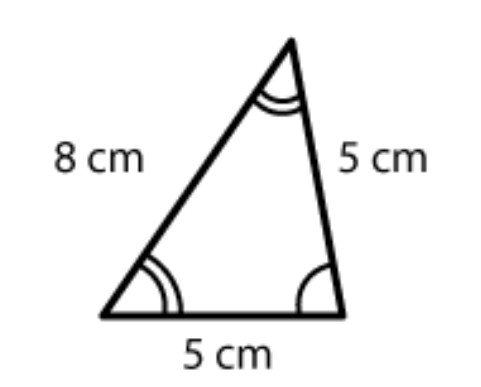 (i) Acute angled triangle (ii) Isosceles triangle
(b)
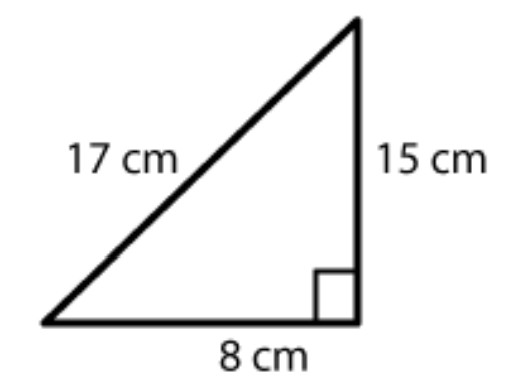 (i) Right angled triangle (ii) Scalene triangle
(c)
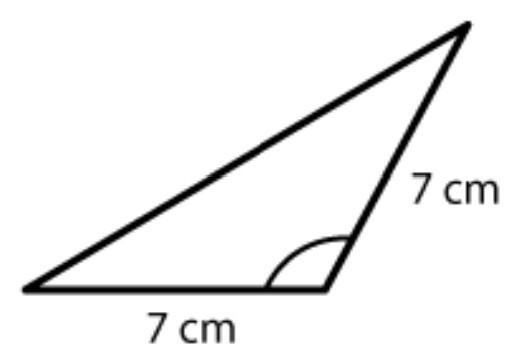 (i) Obtuse angled triangle (ii) Isosceles triangle
(d)
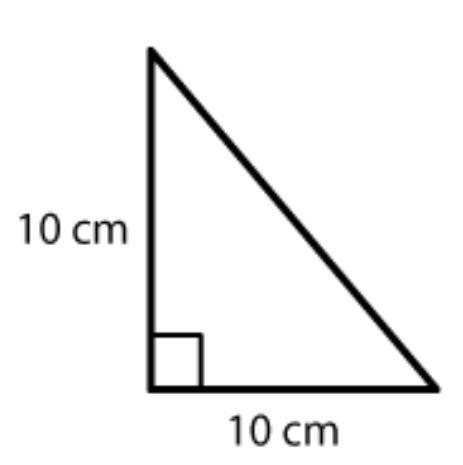 (i) Right angled triangle (ii) Isosceles triangle
(e)
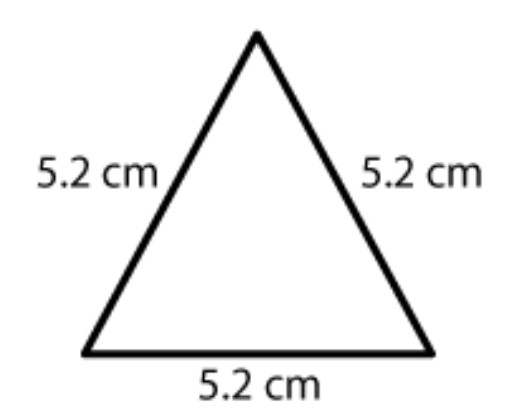 (i) Acute angled triangle (ii) Equilateral triangle
(f)
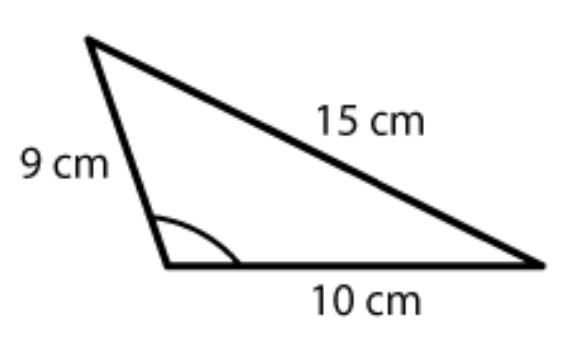 (i) Obtuse angled triangle (ii) Scalene triangle
4. Try to construct triangles using matchsticks. Some are shown here. Can you make a triangle with:
(a) 3 matchsticks?
(b) 4 matchsticks?
(c) 5 matchsticks?
(d) 6 matchsticks?
(Remember you have to use all the available matchsticks in each case)
(a) 3 matchsticks
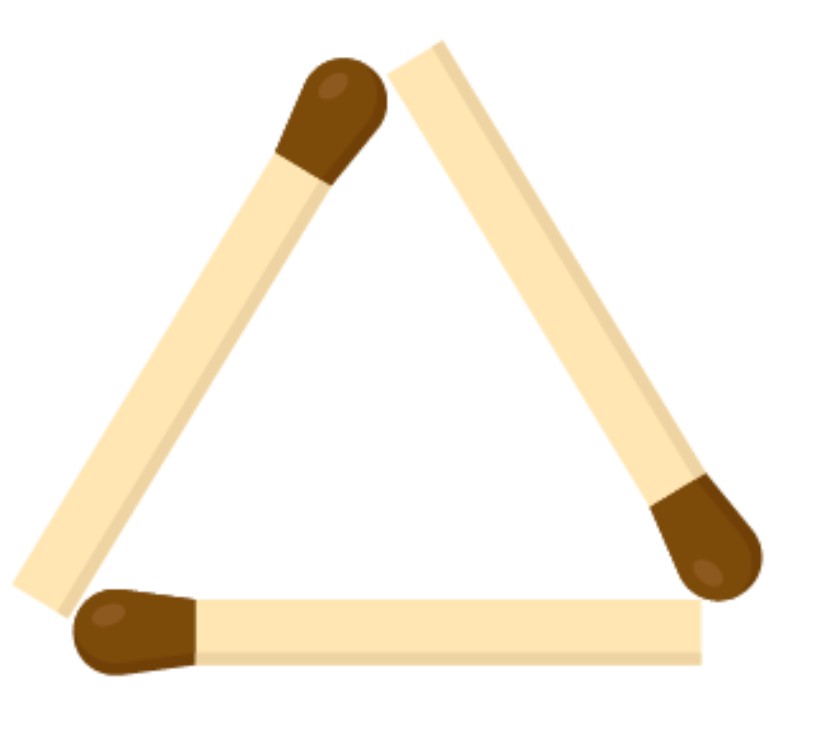 Yes, we can make an equilateral triangle with 3 matchsticks.
(b) 4 matchsticks
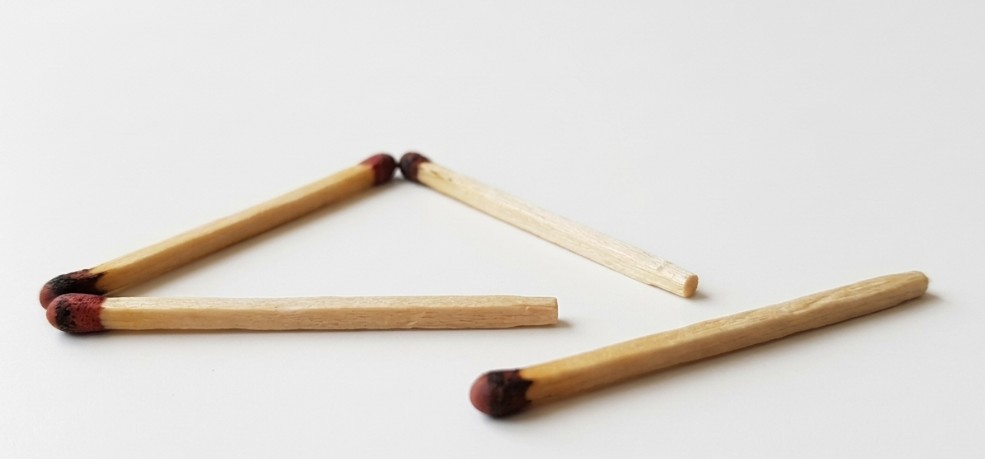 No, we cannot make a triangle with 4 matchsticks. (The sum of any two sides must be greater than the third side).
(c) 5 matchsticks
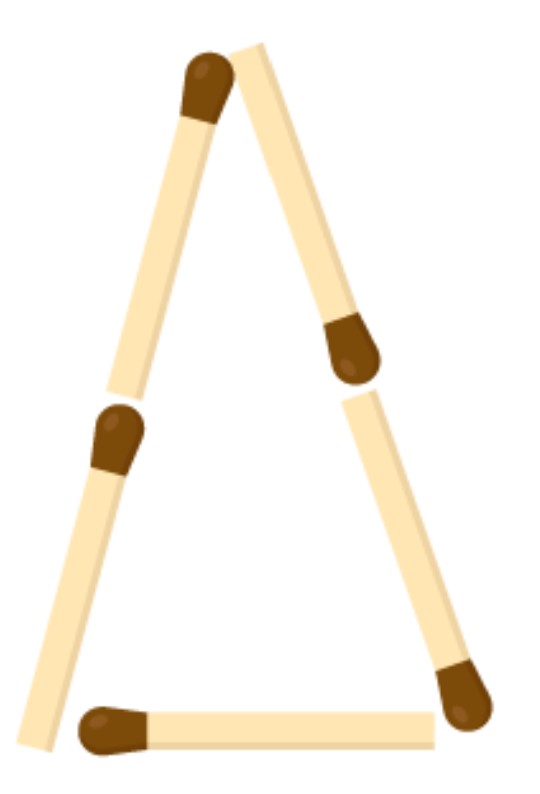 Yes, we can make an isosceles triangle with 5 matchsticks.
(d) 6 matchsticks
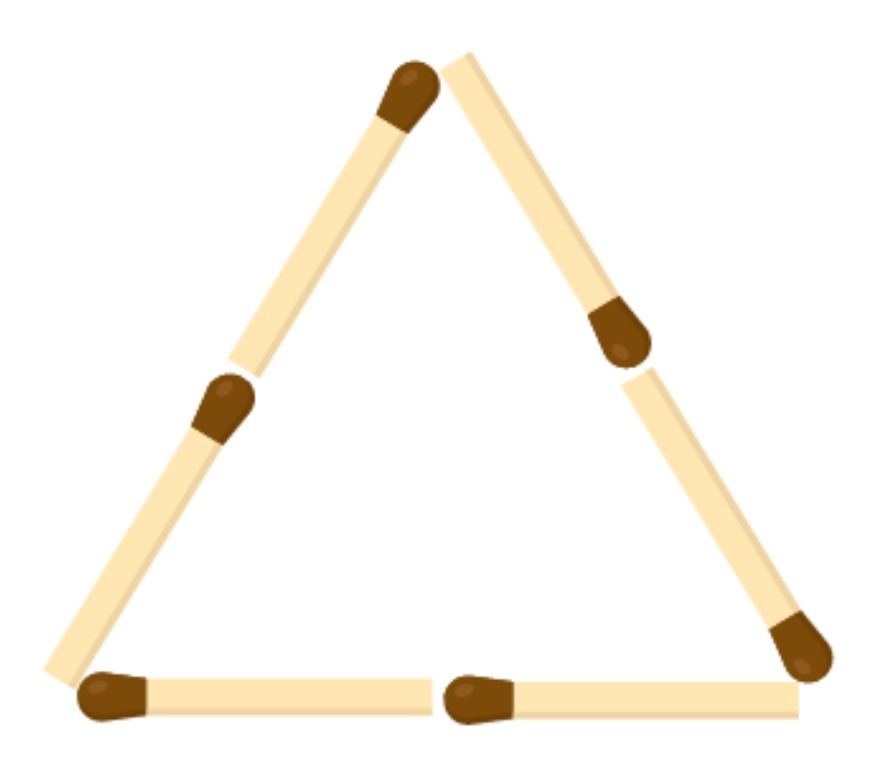 Yes, we can make an equilateral triangle with 6 matchsticks.