Exercise 5.5
1. Which of the following are models for perpendicular lines?
(a) The adjacent edges of a tabletop
(b) The lines of a railway track
(c) The line segments forming the letter ‘L’
(d) The letter V
(a) Yes, adjacent edges of a tabletop are perpendicular.
(b) No, the lines of a railway track are parallel.
(c) Yes, the vertical and horizontal bars of 'L' form a 90° angle.
(d) No, the two lines in 'V' meet at an acute angle.
(b) No, the lines of a railway track are parallel.
(c) Yes, the vertical and horizontal bars of 'L' form a 90° angle.
(d) No, the two lines in 'V' meet at an acute angle.
Correct models are (a) and (c).
2. Let \(\overline{PQ}\) be the perpendicular to the line segment \(\overline{XY}\). Let \(\overline{PQ}\) and \(\overline{XY}\) intersect in the point A. What is the measure of \(\angle PAY\)?
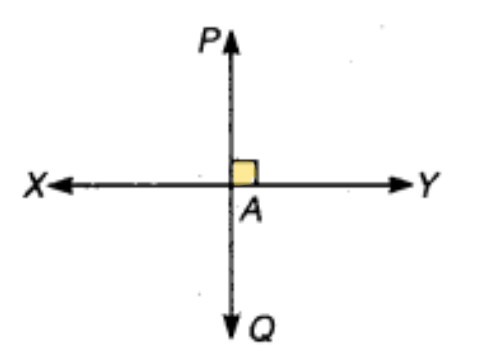
Since \(\overline{PQ} \perp \overline{XY}\), the angle between them is a right angle.
The point of intersection is A.
The point of intersection is A.
∴ \(\angle PAY = 90^\circ\)
3. There are two set-squares in your box. What are the measures of the angles that are formed at their corners? Do they have any angle measure that is common?
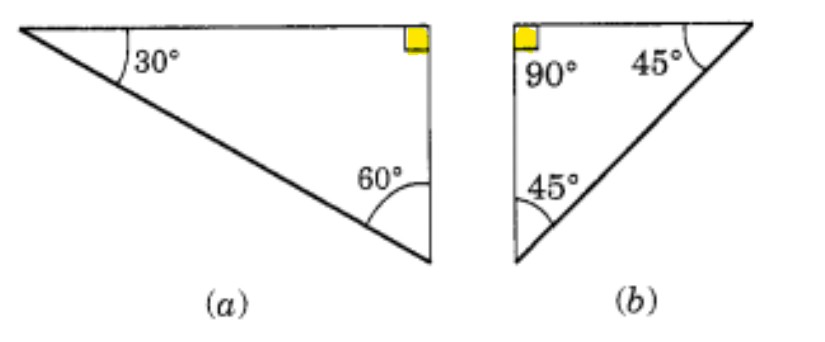
The measures of the angles in the two set-squares are:
(a) 30°, 60° and 90°
(b) 45°, 45° and 90°
(a) 30°, 60° and 90°
(b) 45°, 45° and 90°
Yes, they have a common angle measure of 90°.
4. Study the diagram. The line \(l\) is perpendicular to line \(m\).
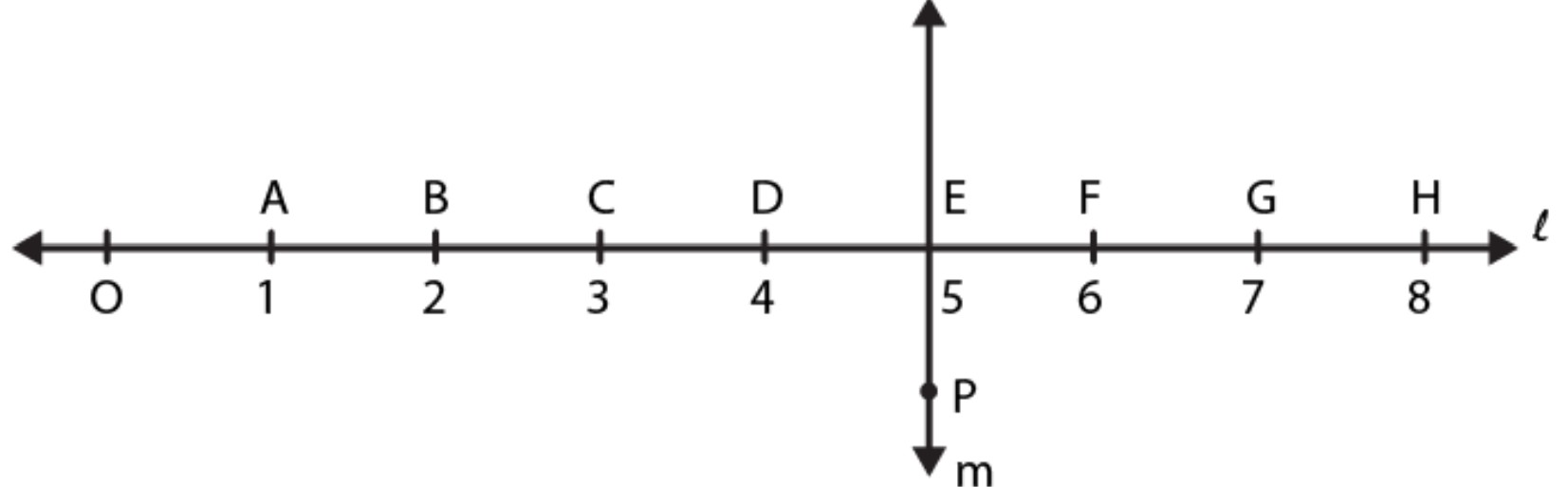
(a) Is CE = EG?
Yes. Since \(CE = 2\) units (from 3 to 5) and \(EG = 2\) units (from 5 to 7).
(b) Does PE bisect CG?
Yes, because E is the midpoint of CG (\(CE = EG\)).
(c) Identify any two line segments for which PE is the perpendicular bisector.
The line segments are \(\overline{BG}\) (since \(BE = EG = 3\) units)
(d) Are these true?
(i) AC > FG → True (\(2 > 1\))
(ii) CD = GH → True (\(1 = 1\))
(iii) BC < EH → True (\(1 < 3\))
Yes. Since \(CE = 2\) units (from 3 to 5) and \(EG = 2\) units (from 5 to 7).
(b) Does PE bisect CG?
Yes, because E is the midpoint of CG (\(CE = EG\)).
(c) Identify any two line segments for which PE is the perpendicular bisector.
The line segments are \(\overline{BG}\) (since \(BE = EG = 3\) units)
and
\(\overline{DF}\) (since \(DE = EF = 1\) unit).(d) Are these true?
(i) AC > FG → True (\(2 > 1\))
(ii) CD = GH → True (\(1 = 1\))
(iii) BC < EH → True (\(1 < 3\))