Exercise 5.1
1. Why is it better to use a divider than a ruler, while measuring the length of a line segment?
Reason: A divider allows you to transfer or compare lengths without reading numbers on a scale.
• With a ruler, you must align the zero mark and read the endpoint — which can cause parallax error (if viewed from an angle).
In short: Divider gives more accurate measurement by avoiding error and allowing direct comparison.
2. Draw any line segment, say AB. Take any point C lying in between A and B. Measure the lengths of AB, BC and AC. Is AB = AC + CB?
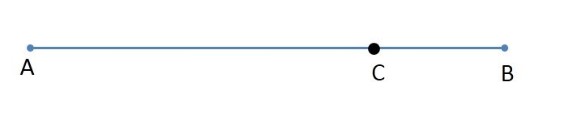 Line segment AB with point C between A and B
Draw AB (say 8 cm), mark C between them (e.g., AC = 5 cm, CB = 3 cm).
If C lies between A and B, then:
\(AC + CB = AB\)
Example: \(5 + 3 = 8\) → true!
\(AC + CB = AB\)
Example: \(5 + 3 = 8\) → true!
Important Note: If \(AC + CB = AB\), then we can be sure that C lies between A and B.
Yes, if C lies between A and B, then AB = AC + CB.
3. If A, B, C are three points on a line such that AB = 5 cm, BC = 3 cm and AC = 8 cm, which one of them lies between the other two?
Given: AB = 5 cm, BC = 3 cm, AC = 8 cm
Check if sum of two distances equals the third:
\(AB + BC = 5 + 3 = 8 = AC\)
So, point B lies between A and C.
So, point B lies between A and C.
Point B lies between A and C.
4. Verify, whether D is the mid point of AG.
From the given number line (as per screenshot):
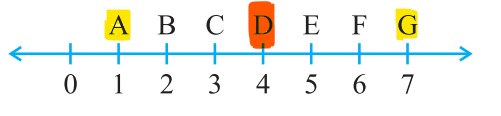
A=1, B=2, C=3, D=4, E=5, F=6, G=7
Length of AG = 7 - 1 = 6 units
Also: AD = 3 units and DG = 3 units (from positions 1 to 4 and 4 to 7)
Midpoint D should divide AG into two equal parts → each part = \(6 / 2 = 3\) units
Since AD = DG = 3 units, ∴ D is the midpoint of AG.
Also: AD = 3 units and DG = 3 units (from positions 1 to 4 and 4 to 7)
Midpoint D should divide AG into two equal parts → each part = \(6 / 2 = 3\) units
Since AD = DG = 3 units, ∴ D is the midpoint of AG.
Yes, D is the midpoint of AG because AD = DG = 3 units.
5. If B is the mid point of AC and C is the mid point of BD, where A,B,C,D lie on a straight line, say why AB = CD?
Let’s draw the line: A — B — C — D

Since B is midpoint of AC
∴ \(AB = BC\) → 1
Since C is midpoint of BD ∴ \(BC = CD\) → 2
From (1) and (2):
Since C is midpoint of BD ∴ \(BC = CD\) → 2
From (1) and (2):
\(AB = BC\) and \(BC = CD\)
∴ \(AB = CD\)