Class 6 • Chapter 4: Basic Geometrical Ideas
Introduction
Geometry studies shapes, sizes, positions and figures made of points and lines. This page gives short, exam-friendly definitions with simple notation using MathJax.
Learning goals
- Recognize and name points, line segments, lines, and rays.
- Tell the difference between intersecting and parallel lines.
- Understand curves: simple, open, and closed.
- Identify sides, vertices, diagonals of polygons.
- Read and write angle notation like \(\angle ABC\).
1) Points
A point shows an exact position. It has no length, width or thickness. We name points with capital letters like \(A, B, C\).
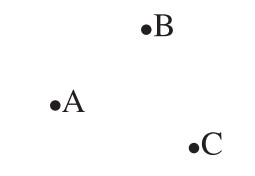
\(\text{Example of : Points } A, B,C\)
2) Line Segment
A line segment is the shortest path joining two points. It has two endpoints.
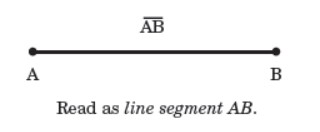
\(\overline{AB}\) means the segment from \(A\) to \(B\).
3) Line
A line extends forever in both directions. It has no endpoints.
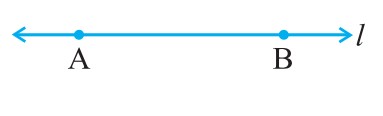
We write \( \overleftrightarrow{AB} \) for the line through points \(A\) and \(B\).
4) Ray
A ray has a starting point and extends forever in one direction.
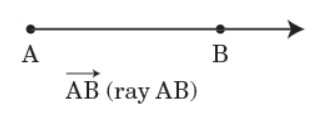
Ray \( \overrightarrow{AB} \) starts at \(A\) and passes through \(B\).
5) Intersecting Lines
Intersecting lines cross at a common point called the point of intersection.
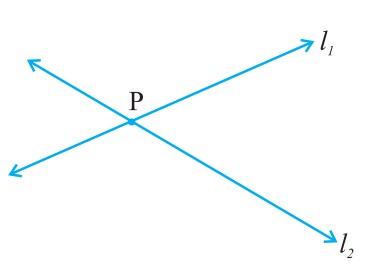
If lines \(l_1\) and \(l_2\) meet at \(P\), we write \(l_1 , l_2 \) intersect at P.
6) Parallel Lines
Parallel lines are in the same plane and never meet, no matter how far extended.
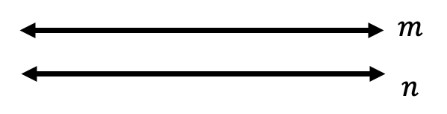
We write \( m \parallel n \).
7) Curves
A curve is any drawing that is not made up of straight line segments only. It can be smooth or zig-zag.
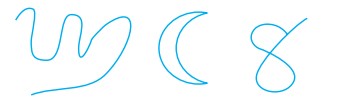
8) Simple Curve
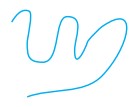
A simple curve does not cross itself.
9) Open and Closed Curve
An open curve has different start and end points.
A closed curve joins back to its start point and encloses a region.
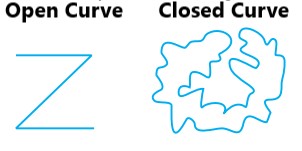
Examples: an open arc vs a closed circle.
10) Sides and Vertices
In a figure made of segments, each segment is a side. The meeting point of two sides is a vertex (plural: vertices).
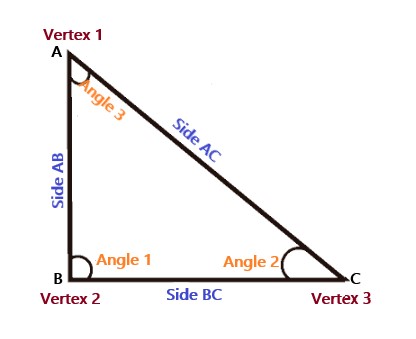
Triangle \( \triangle ABC \) has sides \(\overline{AB}, \overline{BC}, \overline{CA}\) and vertices \(A, B, C\).
11) Diagonals
A diagonal of a polygon joins two non-adjacent vertices.
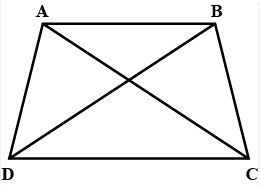
In quadrilateral \(ABCD\), \(\overline{AC}\) and \(\overline{BD}\) are diagonals.
12) Polygon
A polygon is a closed figure made only of line segments. The segments do not cross except at their endpoints.
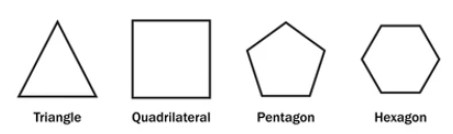
Examples: triangle, quadrilateral, pentagon, hexagon.
13) Angles
An angle is formed by two rays with a common endpoint called the vertex.
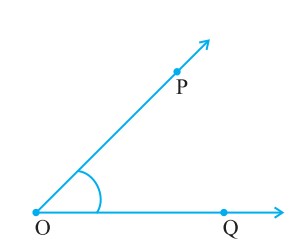
\(\angle POQ\) means the angle with vertex at \(O\) and arms \(PO\) and \(OQ\).
Quick recap
- Use capital letters to name points.
- Segments have two endpoints. Lines have none. Rays have one.
- Lines either intersect or stay parallel.
- Polygons are closed and made only of segments. Diagonals connect non-adjacent vertices.
- Angles are named with the vertex in the middle, like \(\angle ABC\).
You are ready to start the exercises for Chapter 4.