Exercise 4.3
1. Name the angles in the given figure.
Remember: An angle is named using three points: vertex in the middle.
Example: ∠ABC means angle at B between points A and C.
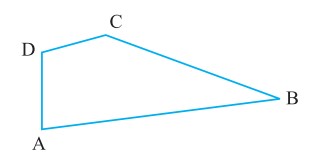 Figure: Quadrilateral ABCD
The angles in the figure are:
• At vertex A: ∠DAB or ∠BAD
• At vertex B: ∠ABC or ∠CBA
• At vertex C: ∠BCD or ∠DCB
• At vertex D: ∠CDA or ∠ADC
• At vertex A: ∠DAB or ∠BAD
• At vertex B: ∠ABC or ∠CBA
• At vertex C: ∠BCD or ∠DCB
• At vertex D: ∠CDA or ∠ADC
Each angle can be named in two ways depending on the order of points:
∠A or ∠DAB, ∠B or ∠ABC, ∠C or ∠BCD, ∠D or ∠CDA
∠A or ∠DAB, ∠B or ∠ABC, ∠C or ∠BCD, ∠D or ∠CDA
2. In the given diagram, name the point(s):
(a) In the interior of ∠DOE
(b) In the exterior of ∠EOF
(c) On ∠EOF
(a) In the interior of ∠DOE
(b) In the exterior of ∠EOF
(c) On ∠EOF
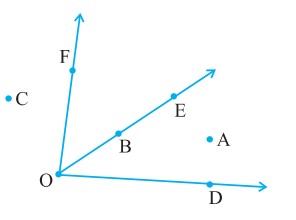 Points: O (vertex), D, E, F on rays, A, B, C around
(a) Interior of ∠DOE
Points inside the angle ∠DOE → only point A lies inside.
Points inside the angle ∠DOE → only point A lies inside.
(b) Exterior of ∠EOF
Points outside the angle ∠EOF → A, C and D.
Points outside the angle ∠EOF → A, C and D.
(c) On ∠EOF
Point lying on ∠EOF → E, B, O, F.
Point lying on ∠EOF → E, B, O, F.
(a) B (b) A, C, D (c) E, B, O, F
3. Draw rough diagrams of two angles such that they have:
(a) One point in common
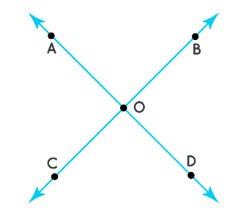 (∠AOB and ∠COD sharing only point O)
(∠AOB and ∠COD sharing only point O)
They share only the vertex — no other points.
(b) Two points in common
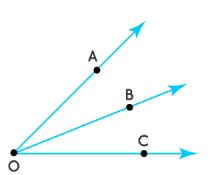 (∠AOB and ∠BOC sharing O and B)
(∠AOB and ∠BOC sharing O and B)
(c) Three points in common
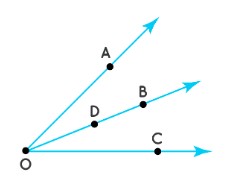 (∠AOB and ∠BOC sharing O, D, and B )
(∠AOB and ∠BOC sharing O, D, and B )
(d) Four points in common
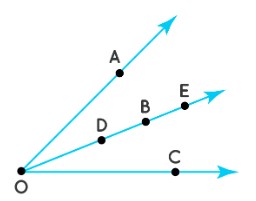 (∠AOE and ∠EOC sharing O, D, B and E )
(∠AOE and ∠EOC sharing O, D, B and E )
(e) One ray in common
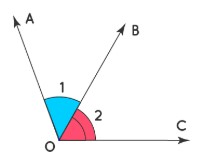 (∠AOB and ∠BOC sharing ray OB)
(∠AOB and ∠BOC sharing ray OB)