Class 6 • Chapter 4: Basic Geometrical Ideas
Exercise 4.1
Q1. Use the figure to name :
(a) Five points
(b) A line
(c) Four rays
(d) Five line segments
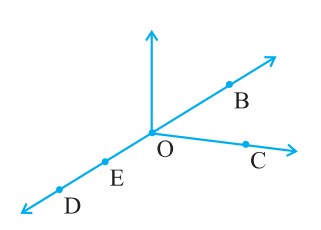
(a) Five points are: D, E, O, B, C.
(b) A line: DE (or \( \overleftrightarrow{DE} \)).
(c) Four rays: \(\overrightarrow{OD}, \overrightarrow{OE}, \overrightarrow{OB}, \overrightarrow{OC}\).
(d) Five line segments: \(\overline{DE}, \overline{EO}, \overline{OB}, \overline{OC}, \overline{DO}\).
Q2. Name the line given in all possible (twelve) ways, choosing only two letters at a time from the four given.
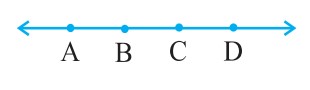
The line passes through points A, B, C, D.
Possible ways (12 total):
\(\overleftrightarrow{AB}, \overleftrightarrow{BA},
\overleftrightarrow{AC}, \overleftrightarrow{CA},
\overleftrightarrow{AD}, \overleftrightarrow{DA}, \)
\( \overleftrightarrow{BC}, \overleftrightarrow{CB}, \overleftrightarrow{BD}, \overleftrightarrow{DB}, \overleftrightarrow{CD}, \overleftrightarrow{DC}\).
\( \overleftrightarrow{BC}, \overleftrightarrow{CB}, \overleftrightarrow{BD}, \overleftrightarrow{DB}, \overleftrightarrow{CD}, \overleftrightarrow{DC}\).
Q3. Use the figure to name :
(a) Line containing point E
(b) Line passing through A
(c) Line on which O lies
(d) Two pairs of intersecting lines
(a) Line containing point E
(b) Line passing through A
(c) Line on which O lies
(d) Two pairs of intersecting lines
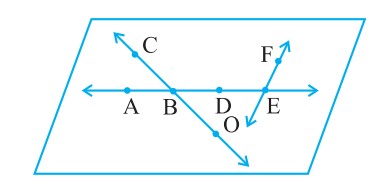
(a) Line containing E : \( \overleftrightarrow{FE} \) and \( \overleftrightarrow{AE} \).
(b) Line through A : \( \overleftrightarrow{AE} \) or \( \overleftrightarrow{AD} \).
(c) Line on which O lies: \( \overleftrightarrow{CO} \) and \( \overleftrightarrow{BO} \).
(d) Intersecting pairs:
(1). \( \overleftrightarrow{AE} \) and \( \overleftrightarrow{CO} \)
(2). \( \overleftrightarrow{AE} \) and \( \overleftrightarrow{FE} \)
(1). \( \overleftrightarrow{AE} \) and \( \overleftrightarrow{CO} \)
(2). \( \overleftrightarrow{AE} \) and \( \overleftrightarrow{FE} \)
Q4. How many lines can pass through (a) one given point? (b) two given points?
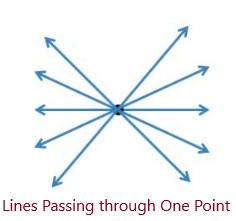
(a) Infinitely many lines can pass through a single point.

(b) Only one unique line can pass through two given points.
Q5. Draw a rough figure and label suitably in each of the following cases:
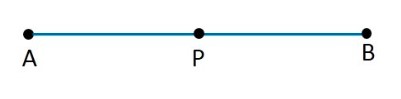
(a) Point P lies on \(\overline{AB}\).
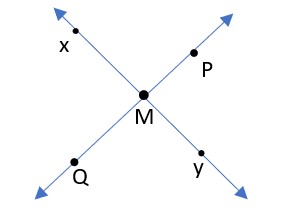
(b) \(\overline{XY}\) and \(\overline{PQ}\) intersect at M.
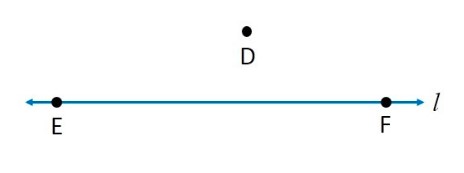
(c) Line \(l\) contains E and F but not D.
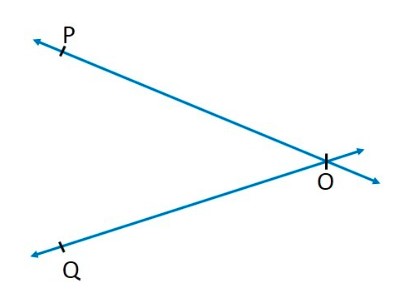
(d) \(\overline{OP}\) and \(\overline{OQ}\) meet at O.
(a) Place point P on segment AB.
(b) Draw XY and PQ intersecting at M.
(c) Draw line l through E and F, ensuring D is not on it.
(d) Draw OP and OQ with common point O.
Q6. Consider the figure of line \( \overleftrightarrow{MN} \).
Say whether the following statements are true or false:
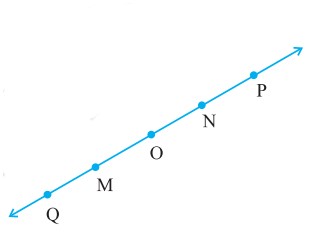
(a) Q, M, O, N, P are points on line \( \overleftrightarrow{MN} \).
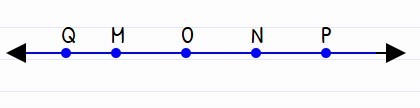
Answer: True
(b) M, O, N are points on segment \( \overline{MN} \).
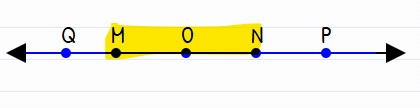
Answer: True
(c) M and N are endpoints of \( \overline{MN} \).
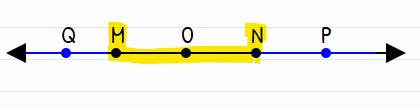
Answer: True
(d) O and N are endpoints of \( \overline{OP} \).
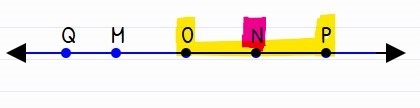
Answer: False (endpoints are O and P).
(e) M is one endpoint of \( \overline{QO} \).
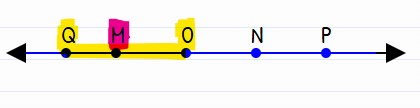
Answer: False (endpoints are Q and O).
(f) M is a point on ray \( \overrightarrow{OP} \).
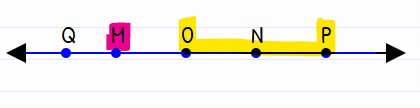
Answer: False
(g) Ray \( \overrightarrow{OP} \) is different from ray \( \overrightarrow{QP} \).
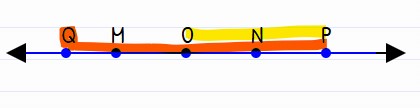
Answer: True
(h) Ray \( \overrightarrow{OP} \) is same as ray \( \overrightarrow{OM} \).
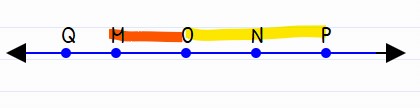
Answer: False
(i) Ray \( \overrightarrow{OM} \) is not opposite to ray \( \overrightarrow{OP} \).
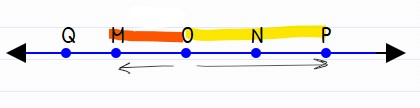
Answer: False (they are opposite rays).
(j) O is not an initial point of ray \( \overrightarrow{OP} \).
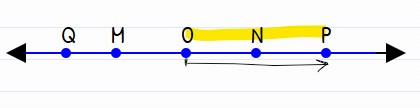
Answer: False (O is the initial point).
(k) N is the initial point of NP and NM.
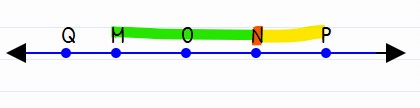
Answer: True