Exercise 3.5
(i)Factor tree (a):
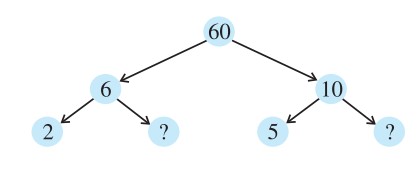 It starts as \(60 = 6 \times 10\).
Then:
\(6 = 2 \times 3\),
\(10 = 2 \times 5\).
It starts as \(60 = 6 \times 10\).
Then:
\(6 = 2 \times 3\),
\(10 = 2 \times 5\).
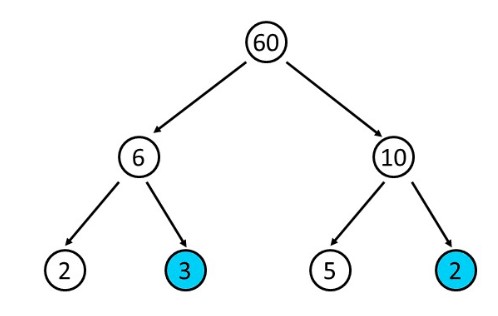
(ii)Factor tree (b):
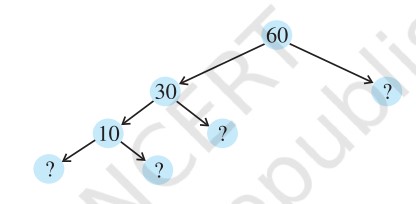 It starts as \(60 = 30 \times 2\).
Then:
\(30 = 10 \times 3\),
then \(10 = 2 \times 5\).
It starts as \(60 = 30 \times 2\).
Then:
\(30 = 10 \times 3\),
then \(10 = 2 \times 5\).
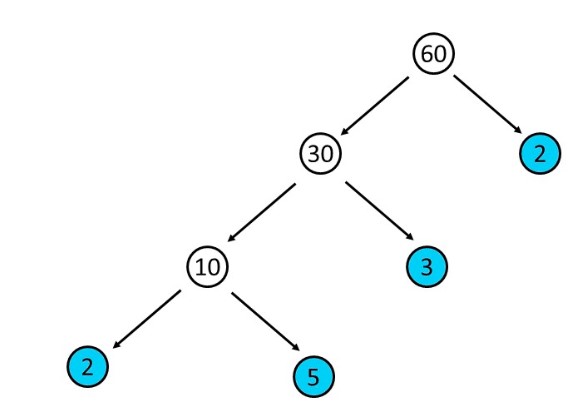
Prime factorisation includes only prime numbers.
So, composite factors and 1 are not included.
Greatest 4-digit number = 9999
Prime factorisation of 9999 step by step:
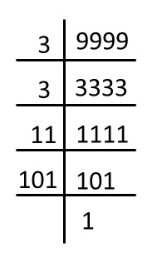
So, \(9999 = 3 \times 3 \times 11 \times 101\)
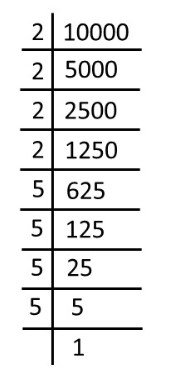
Smallest 5-digit number = 10000
Prime factorisation:
Prime factorisation of 1729:
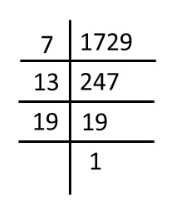
So, \(1729 = 7 \times 13 \times 19\)
So, prime factors: 7, 13, 19
In ascending order: 7, 13, 19
Difference between consecutive factors:
\(13 - 7 = 6\), \(19 - 13 = 6\)
Three consecutive numbers like: (1, 2, 3) or (4, 5, 6) etc.
Lets find product and check:
\( 1 \times 2 \times 3\) = 6 (Divisible by 6)
\( 4 \times 5 \times 6\) = 120 (Divisible by 6)
\( 7 \times 8 \times 9\) = 504 (Divisible by 6)
\( 10 \times 11 \times 12\) = 1320 (Divisible by 6)
Reason:
In any three consecutive numbers:– At least one is even → divisible by 2
– At least one is divisible by 3
So product is divisible by \(2 \times 3 = 6\).
Prime factorisation means only prime numbers are multiplied.
(b) \(56 = 7 \times 2 \times 2 \times 2\) → all primes → ✅
(c) \(70 = 2 \times 5 \times 7\) → all primes → ✅
(d) \(54 = 2 \times 3 \times 9\) → 9 is composite → ❌
No, we cannot say that.
Example: 12 is divisible by both 4 and 6, but \( 4 \times 6= 24 \).
And 12 is not divisible by 24.
Take the four smallest prime numbers:
\(2, 3, 5, 7\)
Multiply them: \(2 \times 3 \times 5 \times 7 = 210\)