Exercise 3.3
1. Using divisibility tests, determine which numbers are divisible by 2, 3, 4, 5, 6, 8, 9, 10, 11.
Quick Divisibility Rules Reminder:
- Divisibility by 2: Last digit even (0,2,4,6,8)
- Divisibility by 3: Sum of digits divisible by 3
- Divisibility by 4: Last 2 digits form a number divisible by 4
- Divisibility by 5: Last digit 0 or 5
- Divisibility by 6: Divisible by both 2 and 3
- Divisibility by 8: Last 3 digits divisible by 8
- Divisibility by 9: Sum of digits divisible by 9
- Divisibility by 10: Last digit 0
- Divisibility by 11: (Sum of digits at odd places) − (Sum at even places) = 0 or divisible by 11
| Number Divisible | By 2 | By 3 | By 4 | By 5 | By 6 | By 8 | By 9 | By 10 | By 11 |
|---|---|---|---|---|---|---|---|---|---|
| 128 | Yes | No | Yes | No | No | Yes | No | No | No |
| 990 | Yes | Yes | No | Yes | Yes | No | Yes | Yes | Yes |
| 1586 | Yes | No | No | No | No | No | No | No | No |
| 275 | No | No | No | Yes | No | No | No | No | Yes |
| 6686 | Yes | No | No | No | No | No | No | No | No |
| 639210 | Yes | Yes | No | Yes | Yes | No | No | Yes | Yes |
| 429714 | Yes | Yes | No | No | Yes | No | Yes | No | No |
| 2856 | Yes | Yes | Yes | No | Yes | Yes | No | No | No |
| 3060 | Yes | Yes | Yes | Yes | Yes | No | Yes | Yes | No |
| 406839 | No | Yes | No | No | No | No | No | No | No |
2. Using divisibility tests, determine which of the following numbers are divisible by 4; by 8:
Rule:
• Divisible by 4 → last 2 digits divisible by 4.
• Divisible by 8 → last 3 digits divisible by 8.
(a) 572
Last 2 digits = 72 → \(72 \div 4 = 18\) → divisible by 4 → Yes
Last 3 digits = 572 → \(572 \div 8 = 71.5\) → not divisible by 8 → No
Last 2 digits = 72 → \(72 \div 4 = 18\) → divisible by 4 → Yes
Last 3 digits = 572 → \(572 \div 8 = 71.5\) → not divisible by 8 → No
(b) 726352
Last 2 digits = 52 → \(52 \div 4 = 13\) → Yes
Last 3 digits = 352 → \(352 \div 8 = 44\) → Yes
Last 2 digits = 52 → \(52 \div 4 = 13\) → Yes
Last 3 digits = 352 → \(352 \div 8 = 44\) → Yes
(c) 5500
Last 2 digits = 00 → \(0 \div 4 = 0\) → Yes
Last 3 digits = 500 → \(500 \div 8 = 62.5\) → No
Last 2 digits = 00 → \(0 \div 4 = 0\) → Yes
Last 3 digits = 500 → \(500 \div 8 = 62.5\) → No
(d) 6000
Last 2 digits = 00 → Yes
Last 3 digits = 000 → \(0 \div 8 = 0\) → Yes
Last 2 digits = 00 → Yes
Last 3 digits = 000 → \(0 \div 8 = 0\) → Yes
(e) 12159
Last 2 digits = 59 → \(59 \div 4 = 14.75\) → No
Last 3 digits = 159 → \(159 \div 8 = 19.875\) → No
Last 2 digits = 59 → \(59 \div 4 = 14.75\) → No
Last 3 digits = 159 → \(159 \div 8 = 19.875\) → No
(f) 14560
Last 2 digits = 60 → \(60 \div 4 = 15\) → Yes
Last 3 digits = 560 → \(560 \div 8 = 70\) → Yes
Last 2 digits = 60 → \(60 \div 4 = 15\) → Yes
Last 3 digits = 560 → \(560 \div 8 = 70\) → Yes
(g) 21084
Last 2 digits = 84 → \(84 \div 4 = 21\) → Yes
Last 3 digits = 084 = 84 → \(84 \div 8 = 10.5\) → No
Last 2 digits = 84 → \(84 \div 4 = 21\) → Yes
Last 3 digits = 084 = 84 → \(84 \div 8 = 10.5\) → No
(h) 31795072
Last 2 digits = 72 → \(72 \div 4 = 18\) → Yes
Last 3 digits = 072 = 72 → \(72 \div 8 = 9\) → Yes
Last 2 digits = 72 → \(72 \div 4 = 18\) → Yes
Last 3 digits = 072 = 72 → \(72 \div 8 = 9\) → Yes
(i) 1700
Last 2 digits = 00 → Yes
Last 3 digits = 700 → \(700 \div 8 = 87.5\) → No
Last 2 digits = 00 → Yes
Last 3 digits = 700 → \(700 \div 8 = 87.5\) → No
(j) 2150
Last 2 digits = 50 → \(50 \div 4 = 12.5\) → No
Last 3 digits = 150 → \(150 \div 8 = 18.75\) → No
Last 2 digits = 50 → \(50 \div 4 = 12.5\) → No
Last 3 digits = 150 → \(150 \div 8 = 18.75\) → No
3. Using divisibility tests, determine which of the following numbers are divisible by 6:
Rule: A number is divisible by 6 if it is divisible by both 2 and 3.
→ Check: (i) last digit even? (ii) sum of digits divisible by 3?
(a) 297144
Even? Yes (ends with 4)
Sum = \(2+9+7+1+4+4 = 27\) → \(27 \div 3 = 9\) → divisible by 3 → Yes
Even? Yes (ends with 4)
Sum = \(2+9+7+1+4+4 = 27\) → \(27 \div 3 = 9\) → divisible by 3 → Yes
(b) 1258
Even? Yes
Sum = \(1+2+5+8 = 16\) → \(16 \div 3 \approx 5.33\) → not divisible by 3 → No
Even? Yes
Sum = \(1+2+5+8 = 16\) → \(16 \div 3 \approx 5.33\) → not divisible by 3 → No
(c) 4335
Even? No (ends with 5) → No
Even? No (ends with 5) → No
(d) 61233
Even? No (ends with 3) → No
Even? No (ends with 3) → No
(e) 901352
Even? Yes
Sum = \(9+0+1+3+5+2 = 20\) → \(20 \div 3 \approx 6.67\) → No
Even? Yes
Sum = \(9+0+1+3+5+2 = 20\) → \(20 \div 3 \approx 6.67\) → No
(f) 438750
Even? Yes
Sum = \(4+3+8+7+5+0 = 27\) → divisible by 3 → Yes
Even? Yes
Sum = \(4+3+8+7+5+0 = 27\) → divisible by 3 → Yes
(g) 1790184
Even? Yes
Sum = \(1+7+9+0+1+8+4 = 30\) → \(30 \div 3 = 10\) → Yes
Even? Yes
Sum = \(1+7+9+0+1+8+4 = 30\) → \(30 \div 3 = 10\) → Yes
(h) 12583
Even? No → No
Even? No → No
(i) 639210
Even? Yes
Sum = \(6+3+9+2+1+0 = 21\) → divisible by 3 → Yes
Even? Yes
Sum = \(6+3+9+2+1+0 = 21\) → divisible by 3 → Yes
(j) 17852
Even? Yes
Sum = \(1+7+8+5+2 = 23\) → \(23 \div 3 \approx 7.67\) → No
Even? Yes
Sum = \(1+7+8+5+2 = 23\) → \(23 \div 3 \approx 7.67\) → No
4. Using divisibility tests, determine which of the following numbers are divisible by 11:
Rule: Find (sum of digits at odd places) − (sum at even places).
Count places from the right (units = place 1).
If result is 0 or divisible by 11, then the number is divisible by 11.
Note: Odd numbers are highlighed in yellow colour and Even numbers in green color
(a) 5445
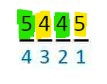 Digits (right to left): 5(1), 4(2), 4(3), 5(4)
Odd places (1,3): \(5 + 4 = 9\)
Even places (2,4): \(4 + 5 = 9\)
Difference = \(9 - 9 = 0\) → Yes
Odd places (1,3): \(5 + 4 = 9\)
Even places (2,4): \(4 + 5 = 9\)
Difference = \(9 - 9 = 0\) → Yes
(b) 10824
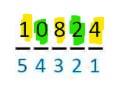 Digits: 4(1), 2(2), 8(3), 0(4), 1(5)
Odd: \(4 + 8 + 1 = 13\)
Even: \(2 + 0 = 2\)
Difference = \(13 - 2 = 11\) → divisible by 11 → Yes
Odd: \(4 + 8 + 1 = 13\)
Even: \(2 + 0 = 2\)
Difference = \(13 - 2 = 11\) → divisible by 11 → Yes
(c) 7138965
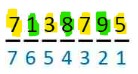 Digits: 5(1), 6(2), 9(3), 8(4), 3(5), 1(6), 7(7)
Odd: \(5 + 9 + 3 + 7 = 24\)
Even: \(6 + 8 + 1 = 15\)
Difference = \(24 - 15 = 9\) → not divisible by 11 → No
Odd: \(5 + 9 + 3 + 7 = 24\)
Even: \(6 + 8 + 1 = 15\)
Difference = \(24 - 15 = 9\) → not divisible by 11 → No
(d) 70169308
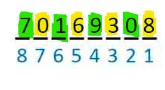 Digits: 8(1), 0(2), 3(3), 9(4), 6(5), 1(6), 0(7), 7(8)
Odd: \(8 + 3 + 6 + 0 = 17\)
Even: \(0 + 9 + 1 + 7 = 17\)
Difference = \(17 - 17 = 0\) → Yes
Odd: \(8 + 3 + 6 + 0 = 17\)
Even: \(0 + 9 + 1 + 7 = 17\)
Difference = \(17 - 17 = 0\) → Yes
(e) 10000001
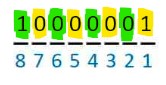 Digits: 1(1), 0(2), 0(3), 0(4), 0(5), 0(6), 0(7), 1(8)
Odd: \(1 + 0 + 0 + 0 = 1\)
Even: \(0 + 0 + 0 + 1 = 1\)
Difference = \(1 - 1 = 0\) → Yes
Odd: \(1 + 0 + 0 + 0 = 1\)
Even: \(0 + 0 + 0 + 1 = 1\)
Difference = \(1 - 1 = 0\) → Yes
(f) 901153
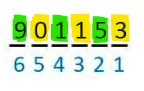 Digits: 3(1), 5(2), 1(3), 1(4), 0(5), 9(6)
Odd: \(3 + 1 + 0 = 4\)
Even: \(5 + 1 + 9 = 15\)
Difference = \(4 - 15 = -11\) → |−11| = 11 → divisible by 11 → Yes
Odd: \(3 + 1 + 0 = 4\)
Even: \(5 + 1 + 9 = 15\)
Difference = \(4 - 15 = -11\) → |−11| = 11 → divisible by 11 → Yes
5. Write the smallest and greatest digit in the blank so the number is divisible by 3.
Rule: We know, a Number is divisible by 3 if sum of all digits is divisible by 3.
(a) __ 6724
Sum of given digits: __+ \(6 + 7 + 2 + 4 = 19\)
We need \(19 + x\) divisible by 3.
We will check all numbers from 1 to 9 for \(x\):
\(19 + 1 = 20\) (No), \(19 + 2 = 21\) (Yes), \(19 + 3 = 22\) (No), \(19 + 4 = 23\) (No), \(19 + 5 = 24\) (Yes), \(19 + 6 = 25\) (No), \(19 + 7 = 26\) (No), \(19 + 8 = 27\) (Yes), \(19 + 9 = 28\) (No)
So Possible numbers are: 2, 5 and 8
Sum of given digits: __+ \(6 + 7 + 2 + 4 = 19\)
We need \(19 + x\) divisible by 3.
We will check all numbers from 1 to 9 for \(x\):
\(19 + 1 = 20\) (No), \(19 + 2 = 21\) (Yes), \(19 + 3 = 22\) (No), \(19 + 4 = 23\) (No), \(19 + 5 = 24\) (Yes), \(19 + 6 = 25\) (No), \(19 + 7 = 26\) (No), \(19 + 8 = 27\) (Yes), \(19 + 9 = 28\) (No)
So Possible numbers are: 2, 5 and 8
Smallest = 2, Greatest = 8
(b) 4765 __ 2
Sum of given digits: \(4 + 7 + 6 + 5 + 2 = 24\)
Let the missing digit be \(x\). Total sum = \(24 + x\)
We need \(24 + x\) divisible by 3.
Since 24 is already divisible by 3, \(x\) must also be divisible by 3.
Possible digits for \(x\) are: 0, 3, 6, 9
Check:
\(24 + 0 = 24\) (Yes), \(24 + 3 = 27\) (Yes), \(24 + 6 = 30\) (Yes), \(24 + 9 = 33\) (Yes)
Sum of given digits: \(4 + 7 + 6 + 5 + 2 = 24\)
Let the missing digit be \(x\). Total sum = \(24 + x\)
We need \(24 + x\) divisible by 3.
Since 24 is already divisible by 3, \(x\) must also be divisible by 3.
Possible digits for \(x\) are: 0, 3, 6, 9
Check:
\(24 + 0 = 24\) (Yes), \(24 + 3 = 27\) (Yes), \(24 + 6 = 30\) (Yes), \(24 + 9 = 33\) (Yes)
Therefore, Smallest digit = 0 & Greatest digit = 9
6. Write a digit in the blank so the number is divisible by 11.
Rule for 11: (Sum of digits at odd places) − (Sum at even places) = 0 or multiple of 11.
(a) 92 __ 389
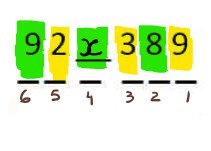 Label positions from right (1 = units):
Digits: 9 (6), 2 (5), x (4), 3 (3), 8 (2), 9 (1)
Odd places (1,3,5): \(9 + 3 + 2 = 14\)
Even places (2,4,6): \(8 + x + 9 = 17 + x\)
Difference = \(|14 - (17 + x)| = | -3 - x | = x + 3\)
Set \(x + 3 = 0\) or 11 → \(x = 8\) (since \(8+3=11\))
Digits: 9 (6), 2 (5), x (4), 3 (3), 8 (2), 9 (1)
Odd places (1,3,5): \(9 + 3 + 2 = 14\)
Even places (2,4,6): \(8 + x + 9 = 17 + x\)
Difference = \(|14 - (17 + x)| = | -3 - x | = x + 3\)
Set \(x + 3 = 0\) or 11 → \(x = 8\) (since \(8+3=11\))
So the missing digit = 8
(b) 8 __ 9484
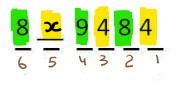 Digits: 8 (6), x (5), 9 (4), 4 (3), 8 (2), 4 (1)
Odd places: \(4 + 4 + x = 8 + x\)
Even places: \(8 + 9 + 8 = 25\)
Difference = \(|(8 + x) - 25| = |x - 17|\)
Set = 0 or 11 → \(x = 6\) (since \(|6 - 17| = 11\))
Odd places: \(4 + 4 + x = 8 + x\)
Even places: \(8 + 9 + 8 = 25\)
Difference = \(|(8 + x) - 25| = |x - 17|\)
Set = 0 or 11 → \(x = 6\) (since \(|6 - 17| = 11\))
So the missing digit = 6
You’ve mastered divisibility! These patterns make big numbers easy to handle. Keep going! 🌟