EXERCISE 2.1
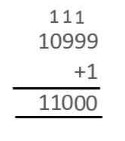
The next three natural numbers after 10999 are found by adding 1 successively.
10999 + 1 = 11000
11000 + 1 = 11001
11001 + 1 = 11002
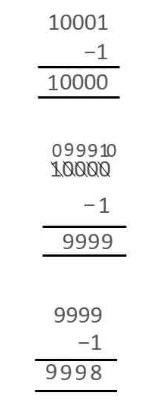
The three whole numbers just before 10001 are found by subtracting 1 successively.
10001 - 1 = 10000
10000 - 1 = 9999
9999 - 1 = 9998
Whole numbers are the set of natural numbers including zero.
The whole numbers between 32 and 53 are 33, 34, 35, ..., 52.
To find the count, we can use the formula: (Last Number - First Number) - 1
Count = \( (53 - 32) - 1 \)
Count = \( 21 - 1 \)
Count = 20
(a) 2440701 (b) 100199 (c) 1099999 (d) 2345670
The successor of a number is the number that comes just after it. We find it by adding 1.
(a) Successor of 2440701 = \( 2440701 + 1 = 2440702 \)
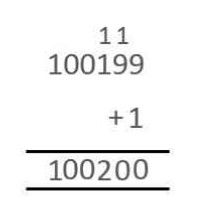
(b) Successor of 100199 = \( 100199 + 1 = 100200 \)
(c) Successor of 1099999 = \( 1099999 + 1 = 1100000 \)
(d) Successor of 2345670 = \( 2345670 + 1 = 2345671 \)
(a) 94 (b) 10000 (c) 208090 (d) 7654321
The predecessor of a number is the number that comes just before it. We find it by subtracting 1.
(a) Predecessor of 94 = \( 94 - 1 = 93 \)
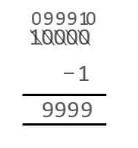
(b) Predecessor of 10000 = \( 10000 - 1 = 9999 \)
(c) Predecessor of 208090 = \( 208090 - 1 = 208089 \)
(d) Predecessor of 7654321 = \( 7654321 - 1 = 7654320 \)
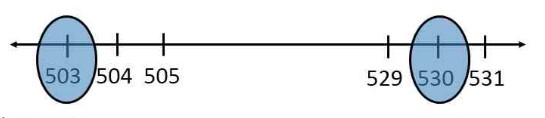
(a) 530, 503 (b) 370, 307 (c) 98765, 56789 (d) 9830415, 10023001
On a number line, the smaller number is always on the left of the greater number.
(a) 503 is to the left of 530. \( 503 < 530 \)
(b) 307 is to the left of 370. \( 307 < 370 \)
(c) 56789 is to the left of 98765. \( 56789 < 98765 \)
(d) 9830415 is to the left of 10023001. \( 9830415 < 10023001 \)
(a) Zero is the smallest natural number.
False
Explanation: The smallest natural number is 1. Natural numbers are counting numbers (1, 2, 3, ...).
(b) 400 is the predecessor of 399.
False
Explanation: The predecessor of a number is found by subtracting 1. The predecessor of 399 is 398. 400 is the successor of 399.
(c) Zero is the smallest whole number.
True
Explanation: Whole numbers include zero and all natural numbers (0, 1, 2, 3, ...).
(d) 600 is the successor of 599.
True
Explanation: The successor of a number is found by adding 1. The successor of 599 is 600.
(e) All natural numbers are whole numbers.
True
Explanation: The set of natural numbers (1, 2, 3, ...) is a part of the set of whole numbers (0, 1, 2, 3, ...).
False All whole numbers are natural numbers.
False
Explanation: The whole number 0 is not a natural number.
(g) The predecessor of a two digit number is never a single digit number.
False
Explanation: The predecessor of the two-digit number 10 is 9, which is a single-digit number.
(h) 1 is the smallest whole number.
False
Explanation: The smallest whole number is 0.
(i) The natural number 1 has no predecessor.
True
Explanation: Natural numbers start from 1, so there is no natural number before 1.
(j) The whole number 1 has no predecessor.
False
Explanation: The whole number 1 has a predecessor, which is 0.
(k) The whole number 13 lies between 11 and 12.
False
Explanation: The whole number 13 comes after 12.
(l) The whole number 0 has no predecessor.
True
Explanation: The whole number system starts with 0, so there is no whole number that comes before 0.
(m) The successor of a two digit number is always a two digit number.
False
Explanation: The successor of the two-digit number 99 is 100, which is a three-digit number.